1. Overview:
a. General characteristics
(1) Very old (3,500-7,000 years)
(2) Very inclusive and tolerant (except for intolerance)
(3) Very complicated and complex
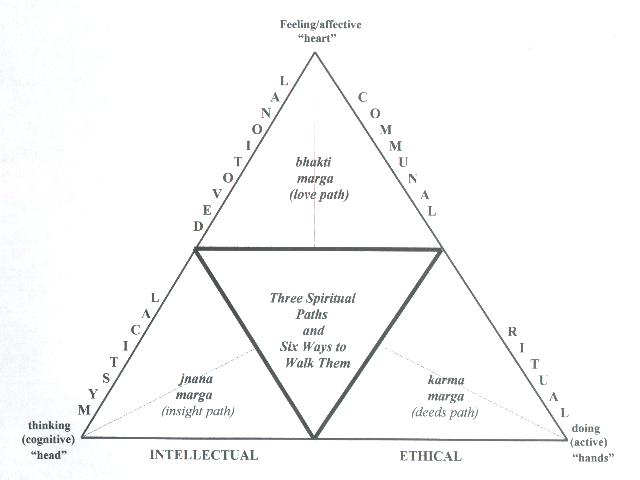
b. A Typological Model for Sorting Hinduism
(1) karma marga= "deed path" = "religion of the hands"
(ritual and/or ethical): emphasis on Rite/Right(a) characterized early Vedic period (1500-600 BCE)
(b) focus: polytheism and ritualism
(c) main scripture is the Vedas (ritualistic material, hymns)(2) jnana marga = "insight path" = "religion of the head"
(intellectual and/or mystical): emph. on Wisdom/Truth(a) characterized Vedantic period (600 BCE-800 CE)
(b) focus: monism and mystical philosophy
(c) main scripture is the Upanishads (philosophicalmaterial)
(3) bhakti marga = "love path" = religion of the heart
(devotional and/or communal): emph. on Faith/Love(a) characterized Sectarian period (800CE-present)
(b) focus: henotheism and worship (puja)
(c) main scripture is Bhagavad Gita ("Krishna is Lord!")
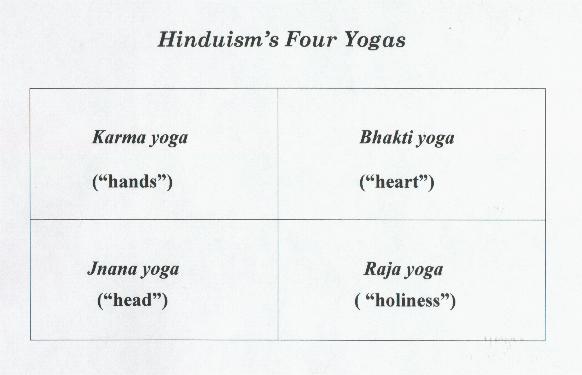
[Note #1: These margas are sometimes labeled as yogas, and numbered at four rather than
three. That larger number is arrived at by isolating out the mystical side of jnana as a
separate discipline called raja yoga.][Preview/Overture: What we will see when we get to the history of Hinduism is that the
whole religion has gone through three major phases, each corresponding to one of these
three margas. Preview:
deed: karma marga - Vedic Period (1200-600 BCE)- polytheistic, ritualistic: Vedas
knowledge: jnana marga - Vedantic Period (600 BCE-800 CE)- monistic, philosophical: Upanishads
devotion: bhakti marga - Sectarian Period (900CE-now)
- henotheistic, devotional: Bhagavad Gita
Details will be spelled out below.]
[Note #2: All three (or four) are found in all the world's religions, though particular
schools, sects or denominations, and individuals generally emphasize one over the
other two (or three). Familiar examples:
(1) Scientology and Unitarianism as religions of the "head";
(2) Protestant Revivalism (e.g., Billy Graham) and Krishna
Consciousness (Hare Krishna) as religions of the "heart";
(3) Roman Catholic sacramentalism, Puritan "work ethic," and
Native American ceremonialism as religions of the "hands";
(4) Hindu yoga and Buddhist zazen as religions of "holiness"/
"wholeness"]
2. Historya. Roots (Pre-Vedic India)
(1) Aryan invasion
(a) H. came to India when nomadic Aryan conquerors
c. 1500 CE brought their polytheistic religion from
Persia in second millennium and combined it with
polytheistic Indus valley native Indian ancient culture
religion;
[1] the Indus Valley people (called Harrapans or
Dravidians) were dark-skinned, settled, peaceful,
agrarian: their religion bore marks of fertility:
feminine "mother earth" dynamic, more typical
of Neolithic tribal religion;
-their culture lasted from about 2150 to
1500 BCE
[2] Aryans were lighter-skinned (but not Caucasian),
nomadic, shepherds, tribal, warlike, uncivilized;
their Indo-European language became the basis
of Sanskrit; their polytheistic religion was patri-
archal and bore a masculine dynamic;
-came in waves 1750-1200 BCE, and probably
were pretty much in control after 1500 BCE
- Aryan society was stratified: (3 classes/castes
that later became the top three castes of four)
(2) Aryan religion ("proto-Hinduism"?)
(a) polytheistic : gods/goddesses (devas) as personifications
of natural forces; a male-dominated pantheon; according
to tradition there are 330,000,000 of these gods and
goddesses(b) sacrificial: movable altars in open places (vs. temples)
- animal sacrifices and libations of milk and soma
(juice or hallucinogenic mushroom????)
- horse sacrifice - only for rulers (too expensive for
general use); horse set loose to roam one year, then
caught and strangled (with the wives of the rajah
participating infertility rites with its body); then
carcass was ritually butchered and eaten by ruler
and family; legend: any man who would perform
100 horse sacrifices would be master of the gods
and the universe; (catch: only 1 per year was
allowed!)
- last performed 8th c. CE
- many other animals sacrificed (from bees to
elephants)b. The Vedic Era (1200-600 BCE)
(1) Definition: that earliest period of Hinduism; focuses on
the most sacred of Hindu scripture: the Vedas (= a
collection of hymns, rituals, chants, and a little philosophy);
key religious/spiritual dynamics at this stage: polytheism
and ritualism (the gods and their relation to ritual,
including sacrifices)(2) The Vedas: problem of dating, since are some pre-Aryan?
(pre-2000 BCE) and some post-Aryan (1500-400 BC);
early oral transmission makes dating difficult; there are
four Vedas (written in Vedic, an ancient precursor of
Sanskrit)(3) The Gods -- the devas of the Vedas (acronyms); devas =
the Vedic gods, each w/its place (loka), none was cosmic
overlord; none was creator of universe; Rta (or Rita =
the impersonal dynamic principle that keeps universe and
society orderly -- what was later called Brahman
(a) Indra - has most hymns to him in Vedas (250); god of
the thunderbolt, clouds, rain; ruler of heaven (cf. Zeus,
Jupiter); the conquerer of Vitra (evil personified);
- often pictured as strong, lecherous, gluttonous,
amoral warlord (cf. Zeus)(b) Agni - god of fire (has 200 hymns); god of priests
(re: sacrifices and fires), lightning, and sun; messenger
of the gods: brings them prayers and sacrifices(c) Varuna - god of universal order (Rita) andkeeper of
social order; very moral himself and forgiver of sins
- did not create Rita, but only oversees it; all gods
are subject to it (both in its natural aspect or in its
moral aspect);(4) Conclusion: The Vedic Era represents the practical dynamic
of religion: karma marga (deed way/discipline); ritual is what
is expected here:
c. Vedantic (Upanishadic) Era (6th c. BCE- 9th c. CE)
(1) Definition: the second, classic period of Hindu history,
which sees a shift in focus:(a) fr/gods and sacrifice to Brahman and its relation to
atman (one's inner spiritual energy-essence); and(b) from the Vedas as a whole to their philosophical
sections, the Upanishads.(2) The Upanishads: "Upanishad" means "a sitting beside,"
("session") which implies a private, personal teaching
from one's spiritual Master ("private lessons"); also called
the Vedanta (= the "end of the Vedas"; 3 senses of "end":
(a) last part(s),
(b) last/least in importance,
(c) final destination/goal; the first two senses prevailed in
Vedic period, the third in the Vedantic period); the term
Vedanta also refers to the tradition of Hindu philosophy
that focuses on these writings and makes the Upanishads
the interpretative "lens" through which the Vedas and other
scriptures are read; the Upanishads, then, are the specula-
tive, philosophical portions of the Vedas; their main
teachings as they were gradually articulated by the Vedantic
philosophers:
Main Concepts:
(a) Brahman (a neuter noun that originally meant the power
inherent in the words of Vedic prayers or spells) is the
Ultimate Reality (not a god, but rather a Power, Presence,
or Principle greater than any god in importance and
potency); it is the Inner Spiritual Essence of the Universe
and of everything in it;[1] Brahman has two aspects:
[a] Brahman Nirguna "without qualities"), utterly
inaccessible to the mind and reason; this is the
true Brahman-as-Mystery; and
[b] Brahman Saguna ("with qualities," and
especially sat [being], cit [consciousness],
and ananda [bliss]; this is Brahman-as-
manifest within the human realm, the
cosmos, culture; in this aspect, Brahman has
a personal side, called Ishvara, and can be
thought, and even called "he" and sometimes
"God"; but this is not Brahman at its depths,
but only the playful surface of the great "Sea
of all souls" that is relatively accessible to
human reason and discourse)[2] Because of its uniqe nature and status, the best
way to talk about Brahman is:[a] Silence, which is to say, not at all;[b] in terms of neti neti ("not this, not that" or
"neither-nor" approach best expressed in
English as "in-" and "un-" words), a via
negativa (Latin for "negative way") of
arriving at the true nature of all reality; and[c] OM or AUM, the most important mantra
(sacred syllable or sound), capturing the whole
reality of Brahman ("A" = eternal truth; "U" =
esoteric knowledge; "M" = happiness in inner
equilibrium)(b) atman (another neuter noun) is the individual spiritual
energy- essence within everything; it is[1] uncreated and eternal;
[2] recyclable; and
[3] none other than Brahman Itself (a drop in the
Great Infinite Spiritual Sea, which is the Infinite Sum
of its infinite drops); note that, as the true inner
spiritual essence of a human being, atman (like
Brahman, which is really is) is non-personal
- because atman is Brahman, anyone has the
right to declare aham brahmasmi = "I am
Brahman!" (which amounts to "I am God!"
- and therefore a heresy! -- for a Westerner);
- also, because a nickname for Brahman is Tat
("That" or "That One"), another famous teaching
of Vedantic Hinduism is tat tvam asi = "That
thou art"/"That's you!" which again means that
you are the Supreme One, because of the funda-
mental identity of the self (atman) and (as!)
Ultimate Reality (Brahman)(c) samsara has two different but related meanings:
[1] the everyday world (or "phenomenal reality"),
which is: maya or "illusory," not absolutely,
but as to its substantiality and importance;
and lila or "frivolity" because of its superfi-
ciality (compared to the fathomless depths
of the True Reality that is Brahman); the
plane of human existence, therefore, is
unstable, transitory, insubstantial, and finally
insignificant;[2] the endless cycles of birth-life-death-rebirth;
"reincarnation" or, more precisely, "transmi-
gration of souls; they are perpetuated by
avidya, which is "ignorance," namely of one's
true nature as atman (it's the delusion that the
self is a separate, individual entity and hence,
confusion about the true nature of reality --
taking one'spersonal identity or "ego-self" as
real), and by karma:
(d) karma has three related meanings:[1] "deed" or "action";
[2] the inevitable effects or consequences of the
deed on its doer; and
[3] the dynamic interconnectedness of everything,
the "law" balances out deeds and consequences,
often entails (requires!) rebirth for justice to
be realized; thus karma has brought us to our
current status, and can help to overcome that
status for future existences; karma can be
good or bad(e) dharma means both
[1] individual duty, virtue, righteousness and
[2] the cosmic order and harmony itself; as duty,
it has the caste system as its backdrop and
frame of reference(f) moksha means "release," "liberation," "emanci-
pation," and "enlightenment" that come with the
realization of one's oneness with The One; it
comes truly only at death, but is experienced in
life (by jivan mukti or mahatma) as samadhi,
a trance-like state in which an individual achieves
an experience of absorption while still living
(3) Other Important Scriptures of this Period[Note: These fall under the category of smriti, or
"traditional scriptures," which are the product of
oral traditions; as opposed to the shruti, or "revealed
scriptures" that came directly from the gods through
rishis, or "seers"](a) Code/Law of Manu (c. 100 b.c.e) (Manu,
according to the Vedas, was the only survivor of
a great flood; was saved by a fish (= Vishnu in
disguise = Noah and Jonah?) = an ethical writing;
gives much information about life in this period,
especially social and religious rules/traditions:[1] caste system (varna = color = caste); each
caste has thousands of jati or subcastes as
well
[a] Brahmin - priests, scholars
[b] Kshatriya - warrior, rulers
[c] Vaishya - merchants, craftspeople
[d] Shudra - peasants, commoners
- each has its duties (dharma)
- only social mobility is through
reincarnation;
[Pariahs or Dalits -- outcastes, untouchables][2] 4 life goals
[a] kama - pleasure
[b] artha - gain
[c] dharma - duty, righteousness
[d] moksha - liberation
- all are good, but only the last is ultimate[3] 4 life stages -- ashramas (rough correlation
to the 4 goals); only apply to the upper 3
castes, Shudras merely serve
[a] student (of Vedas)
[b] householder (married to woman 1/3
own age and of own caste)
[c] hermit (in old age: to forest retreat)
[d] wandering beggar (sannyasi)(b) Sutras (sutra = "thread," lesson), instruction
in outline form; especially important are:[1] Yoga Sutras (c. 100 BCE) = instructionin
hatha yoga (= physical yoga; postures and
breathing); hatha yoga is the preparation for
rajah yoga, the "royal yoga" of
contemplation whose goal is samadhi = the
highest state of meditation (virtual
moksha?), imageless trance, pure
concentration;
- Note that yoga connotes any spiritual
discipline that affords a "yoke" (yoga) to
connect Brahman and atman[2] Kama Sutra by Vatsyayana, 1-4th c.c.e;
= "Love Text" (a sex manual, but scripture
nonetheless)
d. Sectarian Hinduism - (c. 900 C.E./A.D. to present;
aka "Post-Classical Period")(1) Def. --the last period of Hindu history, in which
emphasis shifts to the religious dynamic of henotheism
and devotion; belief in many gods continues, but
interest focuses on a few major deities, and worship
(puja) centers on them (amounting to love and
devotion to gods and goddesses): we get here practical
monotheism couched in a theoretical polytheism;(2) Key Scripture: The Bhagavad Gita = part of longer
poem, The Mahabharata (= the story of a feud
between 2 families since beginning of India, composed
sometime between the 2nd century BCE and the 3rd CE );
the Gita is chapters 25-42 of Mahabharata (100,000
stanzas, the world's longest poem); the Bhagavad Gita
is set on battlefield of the greatest battle between them
(850-650 BC); centers on the conversation between the
warrior Arjuna and his charioteer (= Krishna, who is really
Vishnu in disguise); Arjuna is upset that he has to fight
and kill his old teachers and kinsmen; Krishna reminds
him of his dharma (duty) to go through with this task
and of the eternality of the atman in himself and his
enemies; (Krishna's teachings here are very much those
of Upanishads (dharma,samsara,atman);
- what is new here is the suggestion, made by Krishna,
that devotion (bhakti) to a caring god like him -- who
comes to earth from time to time in the form of
avatars or "incarnations" -- can lead to moksha;
- many see the Bhagavad Gita as marking the shift in
Hindu religiosity toward Sectarian henotheism, in
which a particular god or goddess or manifestation
thereof becomes one's ishta deva (personal deity)
and the object ofone's devotion (bhakti) and worship
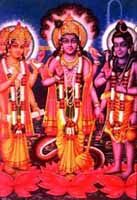
(puja)(3) The main gods: The first three are called the Trimurti
("Three Forms"): Brahma, Vishnu, and Shiva
Separately, they are:
(a) Brahma, the Creator, the least popular of "big 3":
has only 2 or 3temples dedicated to him in India,
and no real following; but his 4-faced statue is in
almost every shrine to Vishnu or Shiva; his consort
or mate is Saraswati, patron goddess of school
children;* * * * * * * * * * * * * * * * * * * * * * * * * *
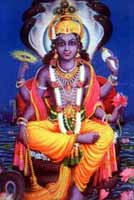
(b) Vishnu,the Preserver (followers are called
Vaishnivas or "Vaishnivites"); god of love,
benevolence, forgiveness (especially concerned
for humankind); has appeared on earth 9 times
as avatars: one of these as the blue-skinned
man-god Krishna; another as Rama; he has
also come as a fish (e.g., in the Manu flood
story mentioned above); and will come a 10th
time to end this age as the horse-headed Kalki;* * * * * * * * * ** * * * * * * * * * * * * * * *
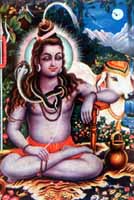
(c) Shiva or (Siva, but still pronounced with the "h"),
the destroyer (followers are called Shaivas or
"Shaivites"); he is by far the most popular of the
deities; he is the god of death, disease and
destruction; dance and music; sexuality and
reproduction (in mythology and sculpture he is
depicted as ithyphallic, i.e., having a constantly
erect penis, and sometimes as having female
sexual organs as well and/or as a hermaphrodite
(left side is female; right side is masculine);
despite his "job description, not a negative god
at all; he merely destroys that which is old and
used up to make way for the new; death also
makes reincarnation and thus spiritual advance-
ment possible; his symbols: trident, drum, snake,
and linga (penis); his female consorts are
Parvati, Durga, and Kali (the latter two being
rather terrifying in appearance because they are
fearsome opposers/devourers of evil)* * * * * * * * * * * * * * * * * * * * * * * * * *
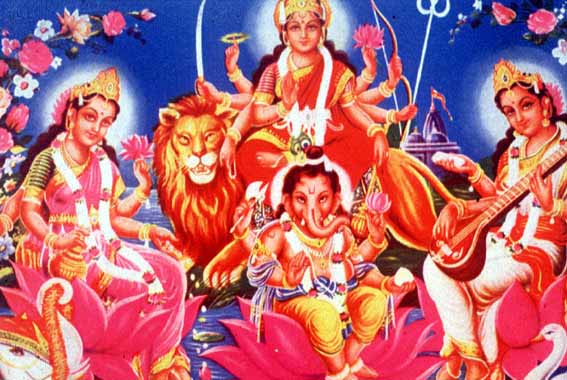
(d) Shakti refers both to the power of Brahman,
which is seen as feminine, and to the various
female consorts of the male gods; pictures above,
left to right, are Lakshmi, consort of Vishnu;
Durga, consort of Shiva, and Sarawati, consort
of Brahma; seated in front of Durga is:
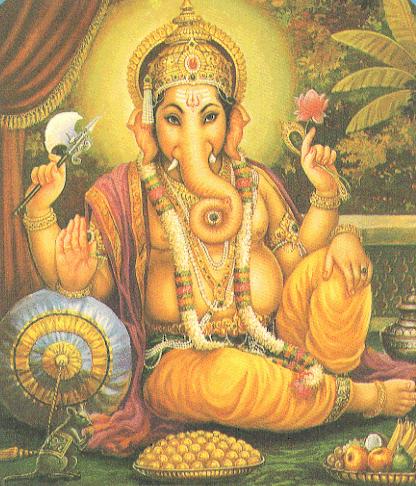
(e) Ganesha (Shiva's elephant-headed son) is a very
popular god among Hindus of all sects; he is the
god of good luck, prosperity and wisdom; remover
of obstacles; patron god of business peoplee. Modern Hinduism --Three Famous Representatives Who
Have Impacted the West ("Universalizers")
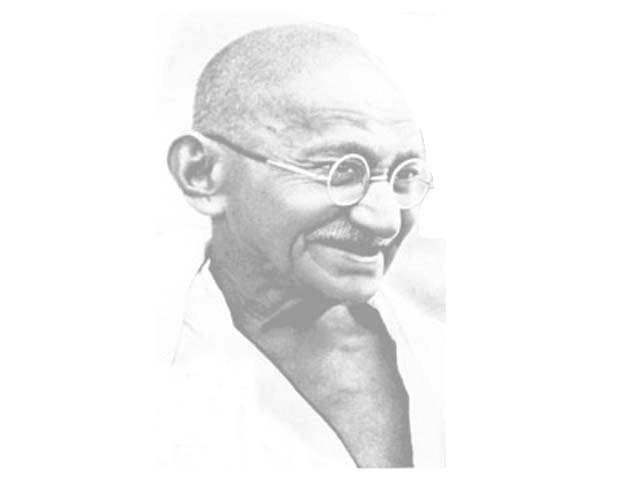
1. Mohandas Karamchand Gandhi (1869-1948), aka
"Mahatma" = great souled one;(a) his life: a lawyer of Vaishya class; spent many
years in S.Africa promoting nonviolent movement
for Indians' rights there; returned to India and in
1920 became leader of India National Congress
(which led to overthrow of British rule in 1947);
the following year, he was assassinated by a
fanatical Hindu nationalist (ag/British, Muslims,
and other foreign influence in India), for whom
Gandhi was too open and accepting(b) his religion: not learned in Hindu scripture; not
a systematic or original religious thinker; not a
theoretician or speculative; not even a mystic;
was very eclectic: was fan of BhagavadGita,
the Sermon on the Mount of Jesus, Thoreau;
had two dominant religious principles [1] "God
is Truth,"so"all religions are true, but each is
truest in its own land"; and (2) satyagraha
(literally, "holding on to the truth") or appeal-
ing to the conscience of the opponent non-
violently; his religious emphasis or path, then,
was a cariety of "hands-on" karma marga
type, of the social-political ethics variety;
his thinking and example were a huge
influence on Martin Luther King, Jr. in the
1960s
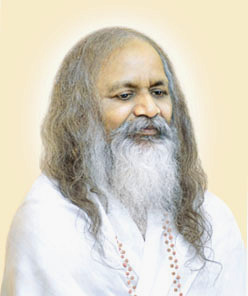
2. Maharishi Mahesh Yogi (1911- )
(a) His life: the guru of the Beatles in the mid-to-
late 1960s, and founder of the Spiritual
Regeneration Movement or TM (Transcen-
dental Meditation); also founder of Maharishi
University in Fairfield, Iowa(b) His religion: meditation, and therefore the
jnana marga type
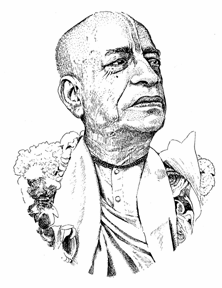
3. A. C. Bhaktivedanta, Swami Prabhupada (d. 1977)
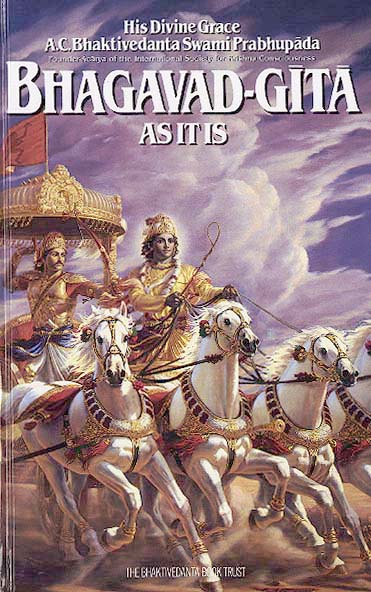
a. His life: greatest and most influential modern interpreter
of the Bhagavad Gita, and founder of the International
Society for Krishna Consciousness (ISKCON) = the
Hare Krishna Movement; author of The Bhagavad
Gita As It Is:
3. SummaryHinduism has endured challenges from reform movements within
India (Vedanta, Jainism, Buddhism,and Sikhism) and from other
exogenous religions (Islam, 15th c. and Christianity, 16th - 19th c.);
and has always managed to tolerate and adjust and maintain the
hearts and minds of most of the people of India; most serious
tensions: with Muslims and Sikhs; one reason for its durability:
it is so complex, there's "something for everyone" -- millions of
gods, many ways to "salvation," etc. ("One can find within
Hinduism almost any form or style of religion that has been
conceived or practiced by mankind. " - Lewis Hopfe); Hinduism
also has an enormous capacity for tolerance of vastly different
beliefs and practices