Theologically there are two main kinds of religion
among the 12 major religions in the modern world,
which generate 4 primary theological or philosophical
views of God or Ultimate Reality:
1. Ones that regard God (or Ultimate Reality by
whatever name) as primarily Other (i.e.,
transcendent, which means or connotes
"beyond," "above," "up there/out there").a. This view leads to what might be called a2. Ones that regard God (or Ultimate Reality by
"Theology of Discontinuity or Separation,"
in which the believer (together with the
human race) is distinct,and almost inevitably
estranged somehow, from God.b. The main types of theology that fit this
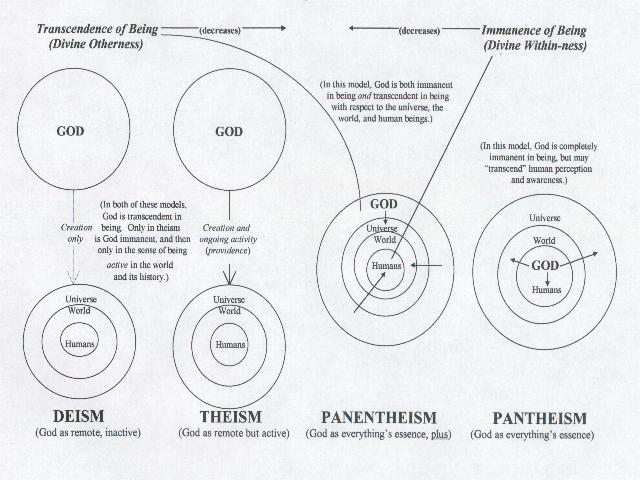
category are theism and deism.(1) Theism is the belief in a God (a) who
is not the stuff of the universe and
who does not dwell in it (or nature),
but in some heavenly realm, (b) who
created the universe other than
"himself," and (c) continues to be
active providentially in its events (i.e.,
in history)- in ancient culture religions (e.g.,(2) Deism is the belief in a God (a) who
Egyptian and Greek) there could
be many such gods -- hence,
polytheism ("many-god-ism")- modern theistic religions in the
Western world (Judaism,
Christianity and Islam) are mono-
theistic, for they believe in only
one such god (Yahweh, God, or
Allah)
is not the stuff of the universe and
who does not dwell in it (or nature),
but in some heavenly realm, (b) who
created the universe other than
"himself," and (c) "programmed"
moral and natural law into it so well
that he no longer needs to (or does)
intervene in its affairs -- hence, no
answered prayers, no miracles, and
no need to worship this largely
disinterested God.- this theology was a revision of
theism by 17th and 18th century
Enlightenment thinkers, whose
main principles were rationalism
("Believe only what makes sense.")
and empiricism ("Seeing is believing.")- Thomas Jefferson and most of our
country's "founding fathers" were
Deists! (So much for "Faith of Our
Fathers"?!)
whatever name) as primarilyWithin (i.e.,
immanent, which means or connotes "indwelling,"
"inner essence," "infused."a. This view leads to what might be called a
"Theology of Continuity or Saturation," in
which the believer (along with Nature)
actually embodies divinity as a birthright --
and is in a very real sense God (or
Ultimate Reality), at least essentially.b. The main types of theology that fit this
category are monism/pantheism and
panentheism.(1) Monism (or more specifically non-
materialistic monism) is the belief that
an Ultimate or Supreme Principle or
Power that (a) is within the stuff of
the universe and who does dwell in it
(and nature), rather than in some
heavenly realm, (b) somehow emits or
emanates an eternal and uncreated
universe as an expression of itself and
(c) continues to be its inner presence,
at levels much deeper than daily/
historical events- This is the sort of view we shall(2) Panentheism is the belief that an
encounter in Hinduism's belief in
Brahman, Buddhism's teaching
about Shunyata, and Taoism's
attention to the Tao. (None of
these religions has a personal
supreme God, only a non-personal
Supreme Something.)- Pantheism (literally "All is God") is
what you get when you use Western
"God" language for this Inner Divine
Essence. The difference between
religious or spiritual monism and
pantheism, therefore, is merely
semantic (though that semantic
difference makes one a theology
and the other a philosophy.
Ultimate or Supreme Principle or Power
that (a) is within the stuff of the universe
and does dwell in it (and nature), but
also (b) is somehow beyond (or
"transcends") the cosmos as well,
but (c) is neverthelss best approached
and experiencedas an inner, deeper
presence in nature and human nature.- whereas pantheism says that God is
the inner spiritual essence of the
universe, panentheism says that
God is the inner essence of the
universe, and then some! the
universe is just as inherently divine
as in pantheism, but there is divinity
"left over" ("transcending" the cosmos)- panentheism is a fairly modern
invention, a synthesis or mixture of
Western theism and Eastern monism________________________________________ The following diagram illustrates the above four
views as they relate to transcendence and immanence:
For the purposes of this course, we may eliminate
deism and panentheism, since no major world
religion has adopted these viewpoints, though one
or two may reflect them. (Confucius' attitude
toward the gods, for example, has been described
by some as "deistic," while Hinduism's view of
Brahman has sometimes been interpeted as
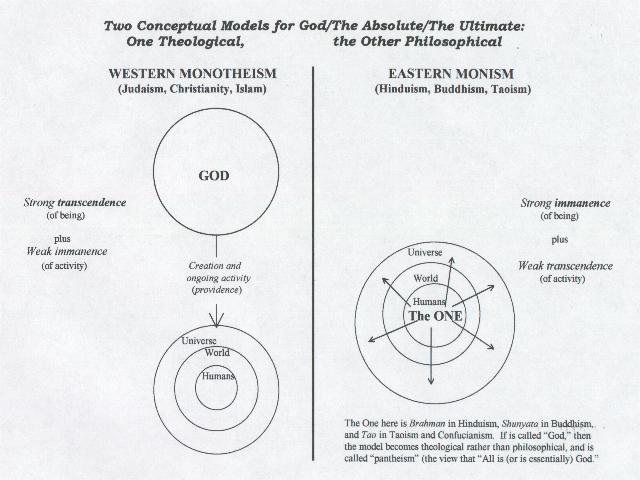
panenthistic.) The options, then, really boil
down to these two:
NOTE: While hardly any religion is purely one or
the other of these two types -- indeed most
religions mix them in one way or another --
every religion does tend to emphasize either
God's otherness (transcendence) or God's
withinness (immanence). Again, as a rule,
religions of the Middle East and West (Judaism/
Christianity/Islam) do the former, while religions
of southern and eastern Asia (Hinduism/Buddhism/
Taoism) do the latter. (But why?!)
B. Ultimate RealityNOTE: This and the following three sections really just
elaborate the two-theology diagram and explanations above.1. WestC. Cosmos and Timea. The Ultimate is a God.2. East
b. God is personal.
c. God is supernatural (i.e. transcendent with
respect to nature)
d. God is active (immanent) in history.
-- Thus the God of Judaism, Christianity,
and Islam is a God of history, not of
nature. (Nature evidences God's creativity
and handiwork, and can be used by God and
by us to learn some things about God and
God's workings; but God is not to be found
in it.)a. The Ultimate is an Energy (Power? Principle?
Presence? Force? Source?), but not a god.
b. This Entity is non-personal.
c. God is inner-natural (i.e. immanent in nature
& human nature)
d. God is "transcends" everyday reality and
history, in the weak sense of escaping our
notice (so deeply within does it lie).
--Thus the Ultimate of Hinduism, Buddhism,
and Taoism is profoundly natural -- the
inner essence of everything and everyone.1. WestD. Humanity (Nature, Predicament, &a. The cosmos is secular (i.e., unsacred).2. East
b. The cosmos is finite: created in a moment
of time (ex nihilo?) and heading toward an
absolute end.
c. Time is linear: it proceeds as a non-
repeatable succession of events.a. The cosmos is sacred (i.e., essentially
divine).
b. The cosmos is infinite: uncreated and
eternal
c. Time is cyclical: it proceeds as a never-
ending succession of events, eras, ages,
lives, etc.
Destiny)1. WestE. Spiritualitya. Humans are mere creatures, in the "image2. East
and likeness of God," perhaps, but essenti-
ally and thoroughly human nonetheless.
b. The human predicament is defined as a
broken relationship with the God who is
"Other." (characterized by sin[fulness],
depravity, fallenness, alienation, etc.)
c. The goal is to have that broken relationship
mended, to "get right with God," either by
one's own efforts at obedicnce (Judaism) or
submission (Islam) to God, or by receiving
God's free give of grace and forgiveness
(Christianity), so as to enjoy communion
(and not just this ritual thereof!) with
God and the other "saved"/saints, perhaps
eternally.a. Humans are essentially divine (one with the
One).
b. The human predicament is defined as
ignorance, namely, of one's true nature:
we don't usually look or act divine! That
ignorance is the source of all of our
misdoings and misery.
c. The goal is to overcome that ignorance with
Enlightenment or Wisdom (not mere
knowledge!), usually with the help of a great
teacher or spiritual master, and thus to realize
the absolute union that one has (and always
really has had) with the UltimateThere are two main kinds of spirituality (i.e., ways of
relating to the Ultimate Reality), corresponding to the
two types of theology described/diagrammed above:1. A spirituality of communication or communion
with the One Above -- reflected in prayer to God-
as-Other (Western: Jud./Chr./Isl.); one might call
this pattern, symbolically, "spirituality of the
mountain top," where one may encounter the
Higher Power; one might describe this spirituality
as extraverted.- this pattern is essentially relational, and the2. A spirituality of identification or union with
problems that arise are set in that context,
mainly in terms of sin (as a human condition)
or sins (as human acts) that spoil the relation-
ship; the need, then, is to "get right with God"
the One Within -- reflected in meditation upon
the One-as-Inner (Eastern: Hinduism/Buddhism/
Taoism.); one might call this pattern, symbolically,
"spirituality of the cave," where one may encoun-
ter the Deeper Power; one might describe this
spirituality as introverted
- this pattern is essentially unitive, and the
problems that arise are set in that context,
mainly in terms of ignorance of one's true
nature, which then lead to bad behaviors and
a lack of self-fulfillment- the need is to "know one’s self" (as none
other than The One Ultimate Self implied in
monism/pantheism!)